
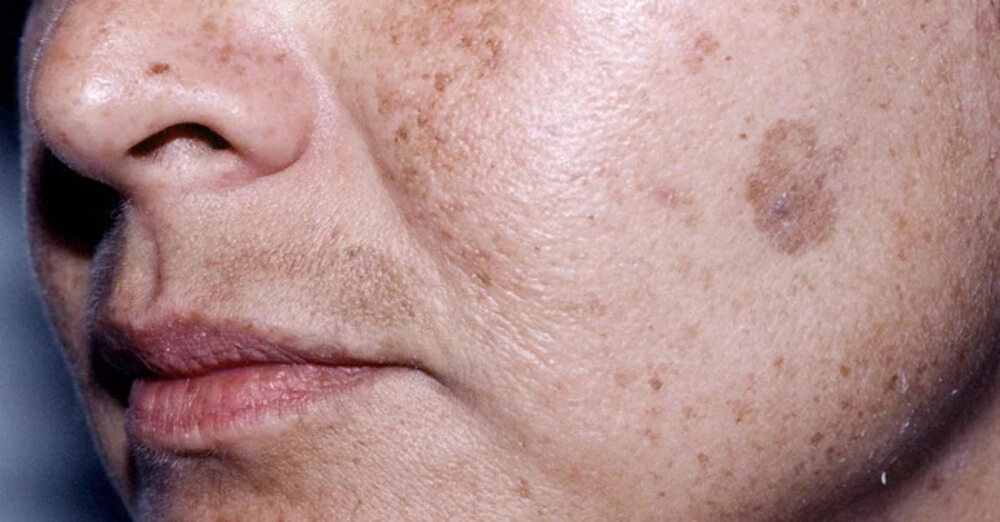
Age spots, commonly referred to as liver spots or sunspots, are flat, dark patches that develop on skin exposed to sunlight over many years. While medically harmless, they reflect cumulative sun damage and become more common with age. Their appearance often raises concern because they can resemble serious skin conditions.
What are the symptoms?
- Age spots appear as flat, smooth areas darker than the surrounding skin
- Their color ranges from light tan to deep brown
- They usually develop on sun-exposed areas such as the face, hands, shoulders, arms, feet, and upper back
- Their sizes vary, and multiple spots may cluster together
- Unlike freckles, they do not fade over time
Why does this disease occur?
- These spots form when pigment-producing cells become overactive
- Ultraviolet radiation stimulates excess melanin production
- With prolonged sun exposure, pigment builds up unevenly in the skin, forming dark patches.
- Artificial sources of UV light, including tanning beds, can produce similar effects
Who is at risk of this disease?
- Individuals with lighter skin are more susceptible to developing age spots
- Those with a history of frequent sun exposure or repeated sunburns face a higher risk
- Although most common after age 50, younger individuals can also develop them due to prolonged sun exposure
What are the possible complications?
- Age spots themselves do not cause physical harm
- The main concern is confusion with melanoma or other skin cancers. Ignoring suspicious changes may delay diagnosis of serious conditions that require prompt treatment
When should you see a doctor?
- Medical advice should be sought if a spot becomes very dark, grows rapidly, develops uneven borders, shows multiple colors, or begins bleeding
- Any new or changing skin lesion should be professionally evaluated
How is this disease diagnosed?
- Doctors usually diagnose age spots through visual examination
- If uncertainty remains, a skin biopsy may be performed. A small skin sample is examined in a laboratory to rule out skin cancer. This procedure is done under local anesthesia
What are the treatment options?
- Treatment is optional and usually cosmetic
- Prescription creams may gradually lighten spots
- Laser and intense pulsed light therapies target pigment-producing cells
- Cryotherapy freezes excess pigment
- Dermabrasion, microdermabrasion, and chemical peels are also used. Each option carries potential side effects and requires medical guidance
How can you take care of yourself at home?
- Over-the-counter fading creams may help reduce pigmentation with regular use
- Products containing hydroquinone, glycolic acid, or kojic acid are commonly used, though irritation may occur
- Cosmetic makeup can help conceal spots
How can this disease be prevented?
- Sun protection remains the most effective prevention strategy
- Avoid peak sunlight hours between 10 a.m. and 2 p.m
- Apply broad-spectrum sunscreen with SPF 30 or higher
- Wear protective clothing, wide-brimmed hats, and sun-protective fabrics
What additional considerations should be kept in mind?
- After cosmetic treatment, strict sun avoidance is essential to prevent recurrence
- These procedures are usually not covered by insurance
- Treatment should only be performed by trained dermatology professionals
Frequently Asked Questions (FAQs)
Q1. Are age spots harmful?
Age spots are benign and medically harmless, but they should be monitored for changes.
Q2. Can age spots become skin cancer?
Age spots do not turn into cancer, but skin cancers can appear similar, making evaluation important.
Important Note: This information is for awareness purposes only. Please consult a healthcare professional for medical advice, diagnosis, or treatment.

Tags: Age sopts Liver spots